Park Mead 2024

Forest School

Forest School is an inspirational process, that offers ALL learners regular opportunities to achieve and develop confidence and self-esteem through hands- on learning experiences in a woodland or natural environment with trees. The growing body of research points to numerous benefits to learner, educator, child and parent alike.

Forest School is the name of a specific ethos. Qualified practitioners carefully facilitate programmes which are uniquely tailored to the needs of the individuals within the group and have the fundamental aim of building participants’ self-esteem, confidence, independence and creativity. The name does not refer to an actual place; it refers to the philosophy.

The Impact of this is the knowledge the children have gained from the Forest School experience.

The impact can be seen through skills, art and craft activities, observations and knowledge of the fruit, plants trees in relation to the seasons and the skills involved in learning how to play Forest School games.

The principals of Forest School state that it is:

  • a long-term process of regular sessions, rather than a one-off or infrequent visits; the cycle of planning, observation, adaptation and review links each session.
  • taking place in a woodland or natural environment to support the development of a relationship between the learner and the natural world.
  • using a range of learner-centred processes to create a community for being, development and learning.
  • aiming to promote the holistic development of all those involved, fostering resilient, confident, independent and creative learners.
  • offering learners, the opportunity to take supported risks appropriate to the environment and to themselves.
  • run by qualified Forest School practitioners who continuously maintain and develop their professional practice.

At Forest School all participants (children and adults) are viewed as:

  • equal, unique and valuable
  • competent to explore & discover
  • entitled to experience appropriate risk and challenge
  • entitled to choose, and to initiate and drive their own learning and development
  • entitled to experience regular success
  • entitled to develop positive relationships with themselves and other people
  • entitled to develop a strong, positive relationship with their natural world

This ethos creates learning communities where deep-level learning and progression are the norm.

www.forestschoolassociation.org/full-principles-and-criteria-for-good-practice

Forest School Blog
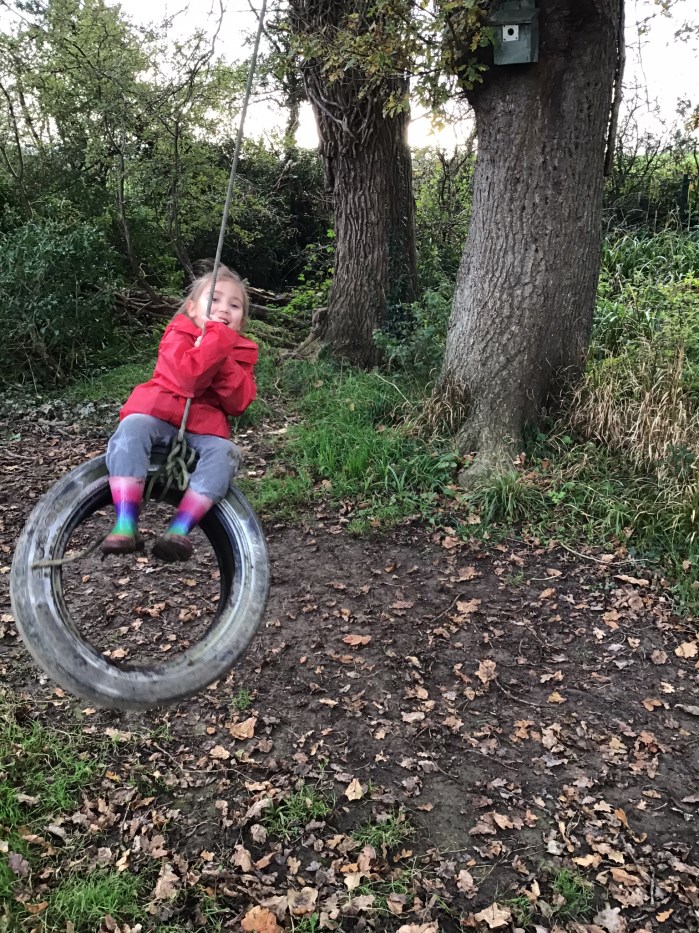
It was great to see the perseverance of the children getting themselves ready, with their wellies and waterproofs as a read more
The Autumn sunshine was beautiful for the Oaks today as they talked about signs of the season. They found sticks read more

Chestnuts Forest School

It was great to see the perseverance of the children getting themselves ready, with their wellies and waterproofs as a class, they raced against a 7 minute timer.

The Impact of Forest School for the children is the knowledge the children have gained from the Forest School experience.

The impact can be seen through the skills gained, tools used, art and craft activities, observations and knowledge of the fruit, plants trees in relation to the seasons and the skills involved in learning how to play Forest School games.

Chestnuts played a game of fox and rabbit. They had a lot of fun, working together as a class, to protect the rabbit inside their circle, from the fox outside!

The children picked some blackberries, hawthorn berries and sloes after identifying them correctly with the adults. They learned they shouldn’t ever eat anything they pick, unless their supporting adults have discussed it with them, because it might make them ill. They managed to collect a huge range of berries, creating a plentiful supply to make their paint with.

Some of the children had a go at painting and mark making with blackberry paint, made from the mushed up blackberries they had collected. They created a beautiful painting on a large sheet of fabric. In the sunshine it was great to see the variety of colours and hues of purples and reds and to see the children’s creative ideas and name writing.

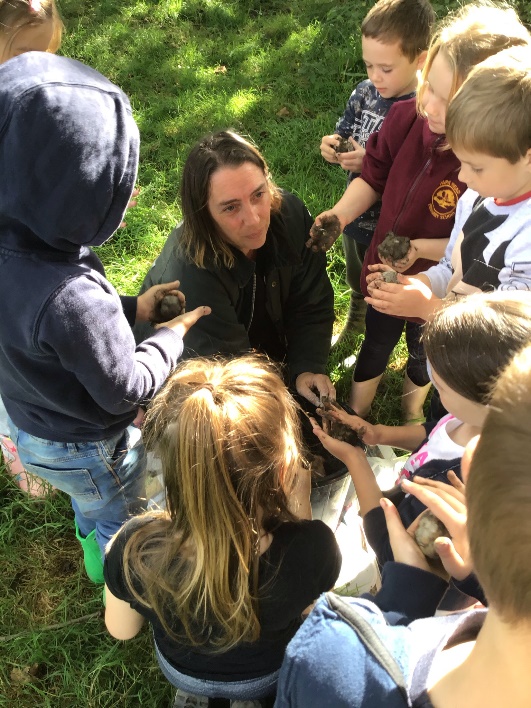
Using some clay and some mud dug from the ground, the children created some ‘seed bombs’ by squishing the clay and incorporating the calendula and poppy seeds inside their rolled spheres. They carefully set them to dry, so they can throw them into their garden beds in the spring as a ‘seed bomb’ to create a lovely flower patch, to then collect seeds from next year. “I wish I could make more and more and more and throw them on the grass to change the school field into a meadow”.

All of the children reflected on what they had done and enjoyed during the session by writing down their favourite activity at the end of the day, supporting each other with discussion and help with sounding out and writing.

Well done Chestnuts class, what a productive, fun filled afternoon!

If anyone has any old, flat white fabric sheets, we could always use them for creative projects with the children at Forest School.

Oaks Forest School

The Autumn sunshine was beautiful for the Oaks today as they talked about signs of the season. They found sticks to collect their leaves onto and created some leaf kebabs!

Using the Autumn leaves they learned how to preserve them by dipping them into molten beeswax. The children used their senses to work out what kind of wax they were using…”it smells like honey!” Some worked together to then create a beautiful hanging leaf mobile, which they hung in their Forest School shelter.

Some of the children took rubbings of their wax dipped leaves and talked about the different colours and textures of the leaves they had found. Some found Oak galls which created a bumpy texture on the underside of the leaves, which looked great in the leaf rubbings.

The class played a game of fox and rabbit, taking it in turns to chase and find a ‘safe’ place in a rabbit burrow as they played.

The Impact of Forest School for the children is the knowledge the children have gained from the Forest School experience.

The impact can be seen through the skills gained, tools used, art and craft activities, observations and knowledge of the fruit, plants trees in relation to the seasons and the skills involved in learning how to play Forest School games.

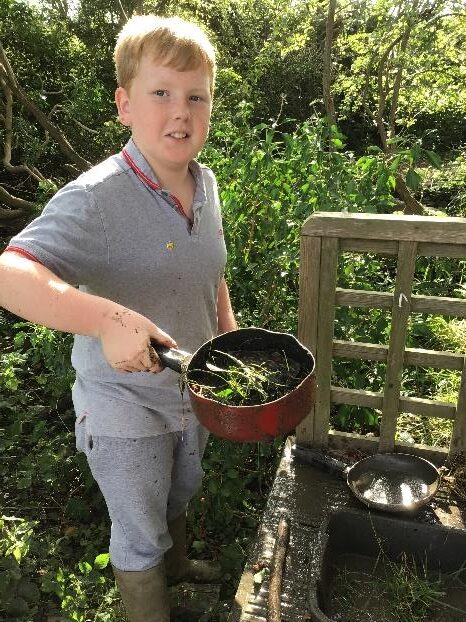
The mud kitchen was popular, with the children creating messy dishes, but also learning some of the names of plants and berries which they added to their creations. There was lots of grassy mud ‘noodles’ and some found some minty ground ivy and blood red hawthorn berries to add into their mixes.